
Rwanda’s Electric Motorcycle Revolution: Driving Toward a Greener Future

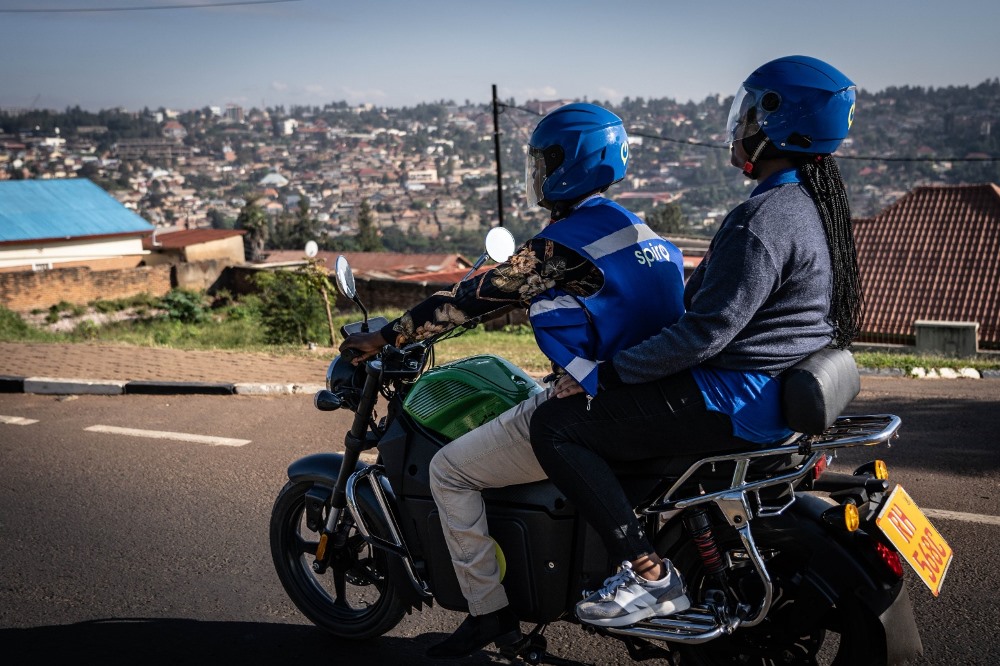
In the early morning in Kigali, Elie Hatungimana pushes his motorcycle out of the compound. He starts it, but no engine roar disturbs the silence. His electric motorcycle moves off quietly, gliding through the misty hills of Rwanda’s capital.
For Hatungimana, a Burundian refugee living in Kigali, as well as thousands of motorcycle taxi drivers, electric mobility has transformed far more than just an engine: it is creating a new future.
“I spend less, earn more, and breathe better,” says the father of three with a smile, his helmet firmly fastened as he prepares to travel around 100 kilometers without a drop of petrol.
Like him, more than 4,000 drivers have already replaced their old petrol-powered motorcycles with quiet electric models supplied by companies such as Ampersand and Spiro, the latter being one of Africa’s leading electric mobility companies.
A National Ambition
Behind these quiet rides lies a clear ambition: to make Rwanda a leading African country in the green transition.
Kigali is more than a modern capital; it is a living laboratory where innovation, climate action, and inclusion come together.
The Rwandan government has set a target of achieving carbon neutrality by 2050.
To reach this goal, it is investing in electric mobility and introducing various incentives, including import tax exemptions, reduced customs duties, and land provided for the installation of battery-swapping stations.
Private companies are responding. Ampersand, which has already attracted support from international investors, aims to have 40,000 electric motorcycles on the road by 2026, in partnership with Chinese giant BYD.
Cleaner Roads, Fuller Pockets
Motorcycle taxi drivers—more than 30,000 in Kigali alone—are at the heart of urban transportation.
Switching to electric motorcycles is more than an environmental choice; it is a matter of economic survival.
Where a tank of petrol could consume up to 60 percent of a driver’s daily earnings, switching to an electric battery can cut that expense by half.
“I can swap my battery in two minutes at a station,” Hatungimana explains.
“I don’t waste time, and I can complete more trips.”
Ampersand and Spiro stations are already spread across Kigali. More than 30 rapid battery-swapping points allow drivers to stay on the road with minimal interruptions.
A Green Economy That Benefits Everyone
Beyond motorcycle taxi drivers, the electric mobility movement is creating a new economic ecosystem, including mechanics trained to repair cleaner engines, battery technicians, and installers of solar-powered charging stations.
Rwanda has recognized that the energy transition is not merely an environmental issue; it is also a means of creating jobs.
According to Ampersand, each electric motorcycle in operation can save more than $1,000 annually in fuel and maintenance costs, keeping more money within the local economy.
These savings benefit families and schools while encouraging a new generation of entrepreneurs to establish businesses.
Challenges Remain
The transition is not without difficulties. The initial cost of an electric motorcycle remains two to three times higher than that of a conventional petrol-powered model.
However, local companies are introducing innovative solutions, including rent-to-own arrangements, flexible credit options, and battery-swapping systems that eliminate the need for drivers to purchase batteries outright.
Meanwhile, the government is working to expand the charging network to convince even the most skeptical drivers to make the switch.
There is also a cultural challenge. For many people, petrol-powered motorcycles symbolize power and freedom. Changing that perception takes time. But in Kigali, cleaner air and quieter streets are gradually shifting attitudes.
Greenland: A Broader Vision
The electric revolution is not limited to two-wheelers. Rwanda is extending the transition to buses and cars.
Companies such as BasiGo have already introduced electric buses to serve public transportation needs in the capital. In the longer term, the ambition is to make the entire public transport fleet greener and develop model green cities.
Recently, the initiative has gained momentum with the introduction of a significant number of electric buses serving routes between Kigali and other provinces.
A symbol of this vision is the Green City Kigali project, a 600-hectare pilot neighborhood planned in Kinyinya and designed as a sustainable urban community.
Environmentally friendly buildings, renewable energy, smart water management, and urban agriculture are all part of the plan to reduce carbon emissions and provide decent housing for more than 30,000 residents.
Supported by the Green Climate Fund and Germany, the project aims to make Kigali an African model for low-carbon urban development.
An Inspiration for the Continent
From Nairobi to Kampala, neighboring countries are watching closely. Rwanda’s electric motorcycles demonstrate that a green transition is possible, even in economies that continue to face significant challenges.
They tell the story of a different Africa: innovative, resilient, and determined to embrace the future.
For Hatungimana, this is not simply a matter of government policy or climate action.
“It’s simple: my motorcycle no longer produces smoke, I earn a better living, and my children breathe cleaner air. What more could I ask for?”
As dusk falls, his motorcycle once again glides through the steep, narrow streets. There is no engine roar, only the gentle sounds of a changing city—a quiet journey toward a greener Rwanda.